
THE IDEA
An oblong of terms
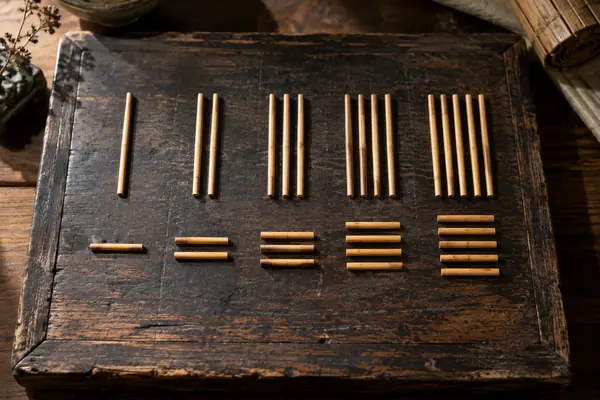
James Joseph Sylvester first used the word matrix in 1850, for an oblong arrangement of terms. Rows run across, columns run down.
See one at work
MATHS IN PLAIN ENGLISH
ROWS × COLUMNS since 1850, by name
AI-generated image, not a photograph of a real person or place.
A matrix is numbers in rows and columns.
It looks like a small spreadsheet, but it comes with rules for adding and multiplying. Those rules let one grid stand for a whole action, such as turning, stretching or moving a shape on screen.
THE SHORT ANSWER
A matrix is a way of keeping related numbers together.
Its rules turn the grid into a tool.
THE IDEA
James Joseph Sylvester first used the word matrix in 1850, for an oblong arrangement of terms. Rows run across, columns run down.
See one at workGRAPHICS
Graphics courses teach that all of a coordinate transformation fits in a 4×4 matrix: rotation, scaling and moving a shape, all in one grid.
How it worksHISTORY
The Nine Chapters on the Mathematical Art, from China between 200 BC and 100 BC, set equation numbers out as a table on a counting board.
See the dates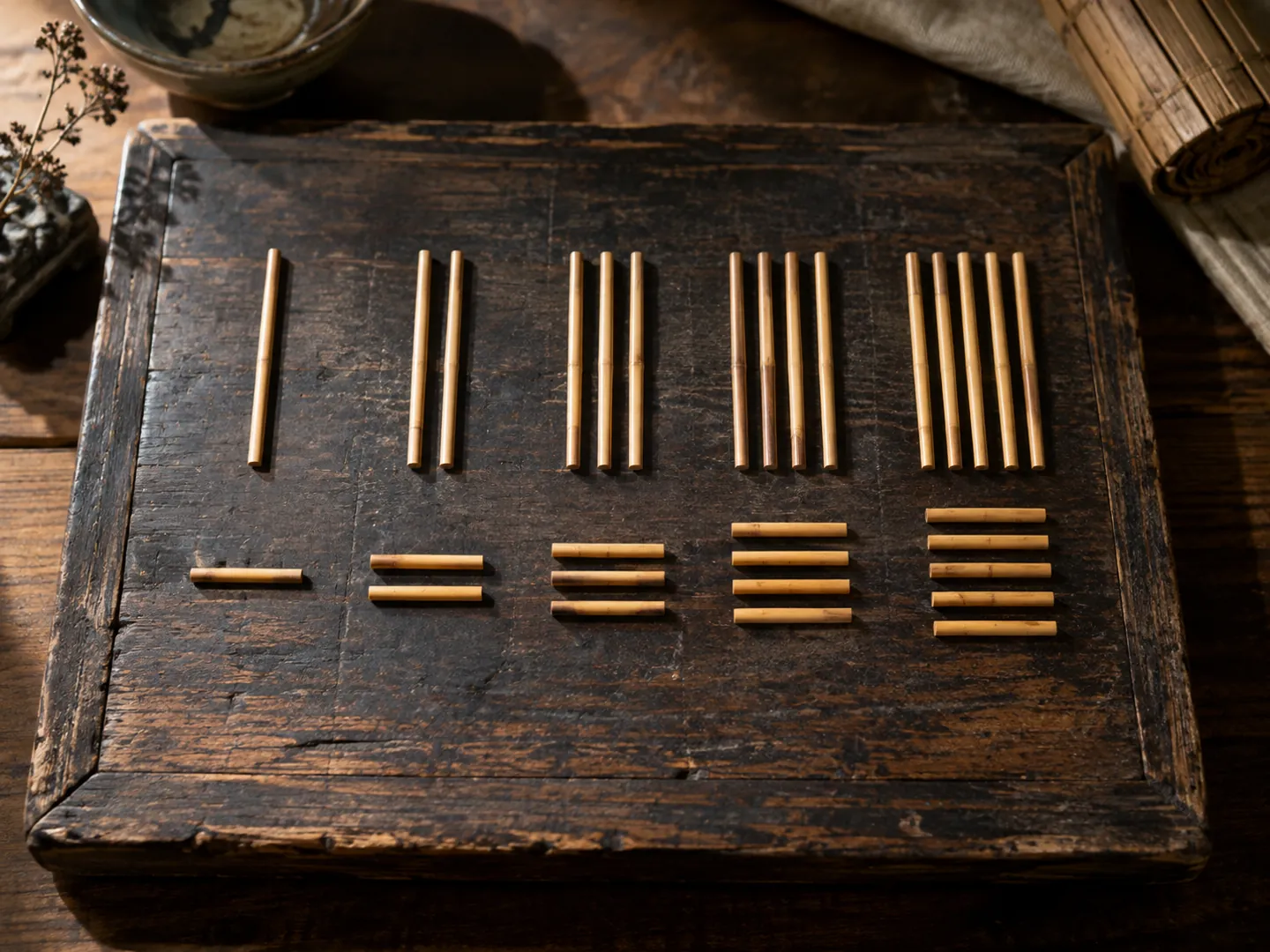
FOUR STEPS TO READ ONE
You do not need any software. A pencil and squared paper are enough to see how a matrix changes a point.
Size is always given rows first. A 4×4 graphics matrix has four of each, so 16 numbers.
Stack x, y and z in a column and add a 1 underneath. That 1 marks it as a point rather than a direction.
Each new coordinate comes from one row of the matrix: multiply it number by number with the column, then add up.
When several moves are chained, the multiplications are applied right to left, so swapping the order can change the result.
TWO NUMBERS WORTH KNOWING
One figure from the history of matrix methods,
one from how screens draw 3D shapes today.
200–100BC
When the Nine Chapters was written
St Andrews' MacTutor history archive dates the Nine Chapters to the Han Dynasty, between 200 BC and 100 BC, and calls its counting-board table the first known example of matrix methods.
HISTORY · MACTUTOR
16 numbers
Numbers in a graphics transformation
A 4×4 matrix has 16 values. The x, y and z axes fill the first three columns and the position of the origin fills the last one.
GRAPHICS · NYU
The extra fourth coordinate is called a homogeneous coordinate. Points have it set to 1 and directions to 0, which is why sliding a shape moves its points but not its directions.
A QUICK TRANSFORMATION CHECK
Pick a move to see which part of a 4×4 graphics matrix it uses. The bar shows how much of the grid the move changes.
Based on university computer graphics course notes from NYU and UC Berkeley.

A SHORT HISTORY
Chinese mathematicians used a table of coefficients on a counting board over 2,000 years ago. Seki in Japan (1683) and Leibniz in Europe (1693) worked with determinants, and Gauss used elimination in 1803 to 1809 to study the orbit of the asteroid Pallas.
Sylvester named the matrix in 1850. In 1858 Arthur Cayley's Memoir on the Theory of Matrices gave the first abstract definition and an algebra for adding, multiplying and inverting them, described by the mathematician Nicholas Higham as the first paper on matrix algebra.
In conversation
A rectangular grid of numbers arranged in rows and columns. Sylvester, who coined the word in 1850, called it an oblong arrangement of terms. What makes it useful are the rules for combining matrices.
Course notes from NYU say all the information of a 3D coordinate transformation can be placed in a 4×4 matrix. The extra row and column let a slide (translation) be written as a matrix alongside rotation and scaling.
Yes. UC Berkeley's graphics notes say a sequence of transformation matrices is applied right to left, so the same moves in a different order can give a different result.
No single person. The Nine Chapters, from China between 200 BC and 100 BC, used a table of coefficients. Sylvester named the matrix in 1850, and Cayley's 1858 memoir set out matrix algebra.
They look alike, as both are grids of rows and columns. A matrix adds mathematical rules for adding, multiplying and inverting whole grids, which is what lets one matrix stand for an action.
Each figure on this page comes from the sources below.
ABOUT THIS NAME
doodlematrix.com is part of the DoodleSale portfolio. It isn't in an auction right now, but you can ask about leasing it.